
September 23, 2026
The Quietest Risk Factor. What Loneliness Actually Does to an Aging Body
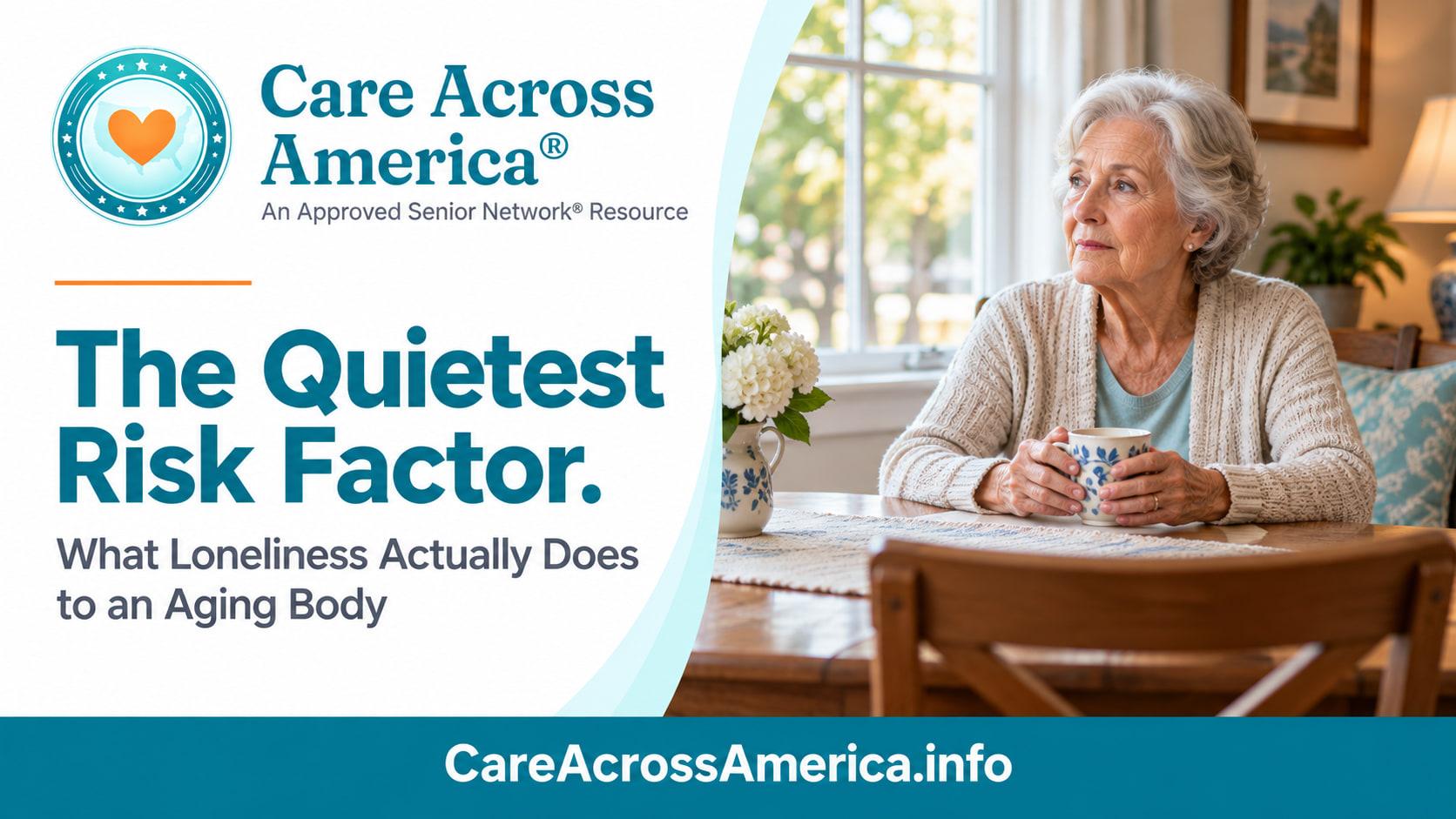
Most families notice the practical problems first. The unopened mail. The expired milk. The bruise nobody can explain.
Loneliness is harder to see, and it does more damage than almost anyone expects.
How serious is loneliness for older adults?
In 2023 the U.S. Surgeon General issued a formal public health advisory titled Our Epidemic of Loneliness and Isolation. It is worth knowing what that means. Surgeon General advisories are reserved for urgent public health threats. Previous ones have covered tobacco and opioids.
The advisory found that the mortality risk of chronic loneliness is comparable to smoking 15 cigarettes a day.
For older adults specifically, it documented:
- 29 percent higher risk of heart disease
- 32 percent higher risk of stroke
- 50 percent higher risk of developing dementia
Those are not soft numbers about mood. They describe a body under sustained stress.
Why does being alone affect physical health?
The advisory points to chronic inflammation, elevated stress hormones, disrupted immune function and changes in gut bacteria.
There is a simpler layer underneath the biology, and any home care nurse will recognize it.
People who are alone stop doing things. Cooking a real meal for one person feels pointless, so nutrition slides. Nobody notices the new cough, so it becomes pneumonia. Nobody sees the medication organiser still full on Thursday. Nobody is there when the stumble in the hallway turns into an hour on the floor.
Isolation does not only make illness more likely. It makes every existing problem harder to catch.
Loneliness and social isolation are not the same thing
This distinction matters when you are trying to help.
Social isolation is countable. How many people did your mother actually speak to this week?
Loneliness is the gap between the connection someone wants and the connection they have.
The two often travel together, but not always. A widower who sees his children weekly can still be profoundly lonely, because the person he wants to talk to is gone. A woman living alone by choice, with a busy phone and a book club, may be perfectly content.
Treat the one your parent actually has. Filling a lonely person's calendar with strangers can make things worse.
What are the warning signs?
Almost nobody says "I am lonely." Admitting it feels like confessing a personal failure, especially for a generation raised not to complain.
Watch for the shape of the days instead:
- Meals replaced by crackers, toast or nothing
- The phone ringing out, then a cheerful callback hours later
- A hobby, a church, a card game that quietly stopped
- The same chair, the same television, most of the day
- Sleeping far more, or barely at all
- A home that has drifted below its usual standard
- New irritability, or a flatness that is easy to mistake for tiredness
One of these means little. Four of them together is a pattern.
Our guide on signs your parent needs help at home works through the wider set of changes worth watching for.
Find a Home Care Provider Near You
Search the Care Across America directory to connect with trusted home care agencies serving your city and state.
Browse the Home Care DirectoryWhy does this happen so suddenly to people who were fine?
Usually because something removed the structure, not the desire.
The most common triggers are the loss of a spouse, the loss of driving, and the loss of a role. Driving is the one families underestimate most. When a car goes, so does church, the grocery store, the standing lunch, the barber and the ability to change your own mind about your own day. The social life does not end because the person changed. It ends because the transport did.
What actually helps?
Not advice. Not a phone call telling someone they should get out more.
What works is structure and presence, delivered by the same person often enough to become a real relationship.
- Regular, predictable visits. A Tuesday and Friday that exist whether or not anyone is in the mood. Predictability is what turns visits into a routine worth getting dressed for.
- The same caregiver. Continuity is the whole thing. A rotating cast of new faces is not company, it is a series of introductions.
- Transport back to what was lost. Often the highest-value hour in the week is the drive to church, the salon or the coffee shop, not the hour spent in the living room.
- Shared activity rather than supervision. Cooking together, sorting photographs, a walk, a hand of cards. Doing something alongside a person is different from watching them.
- Reconnection with what already existed. The old friend who stopped calling after the funeral often just did not know what to say. A caregiver who helps make that call is worth more than any new activity.
Where home care fits, honestly
A paid companion is not a replacement for a daughter or a friend of fifty years. Anyone who tells you otherwise is selling something.
What companion care genuinely provides is consistency that families spread across three states cannot: a person who turns up on the same days, learns the routine, notices the cough and the unopened pill organiser, and gives your parent a reason to be up, dressed and in the front room by ten.
That is not a small thing. Given what the evidence says about isolation and the aging body, it may be one of the most protective hours in the week.
Sources
Frequently Asked Questions
Is loneliness really a health risk, or just an emotional one?
Both. The 2023 U.S. Surgeon General's Advisory on loneliness and isolation found the mortality risk comparable to smoking 15 cigarettes a day, along with a 29 percent higher risk of heart disease, a 32 percent higher risk of stroke, and a 50 percent higher risk of dementia in older adults.
What is the difference between loneliness and social isolation?
Social isolation is measurable. It is how few people someone actually sees and speaks to. Loneliness is the felt gap between the connection a person wants and the connection they have. Someone can be isolated without feeling lonely, and someone can feel deeply lonely in a full house.
How do I know if my parent is lonely if they say they are fine?
Watch behavior rather than answers. Look for meals skipped or replaced by snacks, a phone that goes unanswered, hobbies quietly abandoned, days spent in the same chair, sleeping much more or much less, and a house that has slipped from its usual standard. People rarely report loneliness directly, partly because admitting it feels like a failure.
Can a paid caregiver really help with loneliness?
A caregiver is not a substitute for family or lifelong friends, and it is honest to say so. What consistent companionship does provide is a reliable human presence, a reason to get dressed, someone who notices changes early, and often transport back to the church, club or coffee shop that isolation quietly ended.
Written By
Valerie VanBooven RN BSN
Valerie VanBooven RN BSN is a registered nurse, wife, mom, and published author of several books on long-term care and elder care. She is the Founder and Co-Owner of Approved Senior Network® and the founder of Care Across America®.
More from Care Across America
Find a Home Care Provider Near You
Search the Care Across America directory to connect with trusted home care agencies serving your city and state.
Browse the Home Care DirectoryRecent Posts