
September 29, 2026
What a Companion Caregiver Actually Does All Day
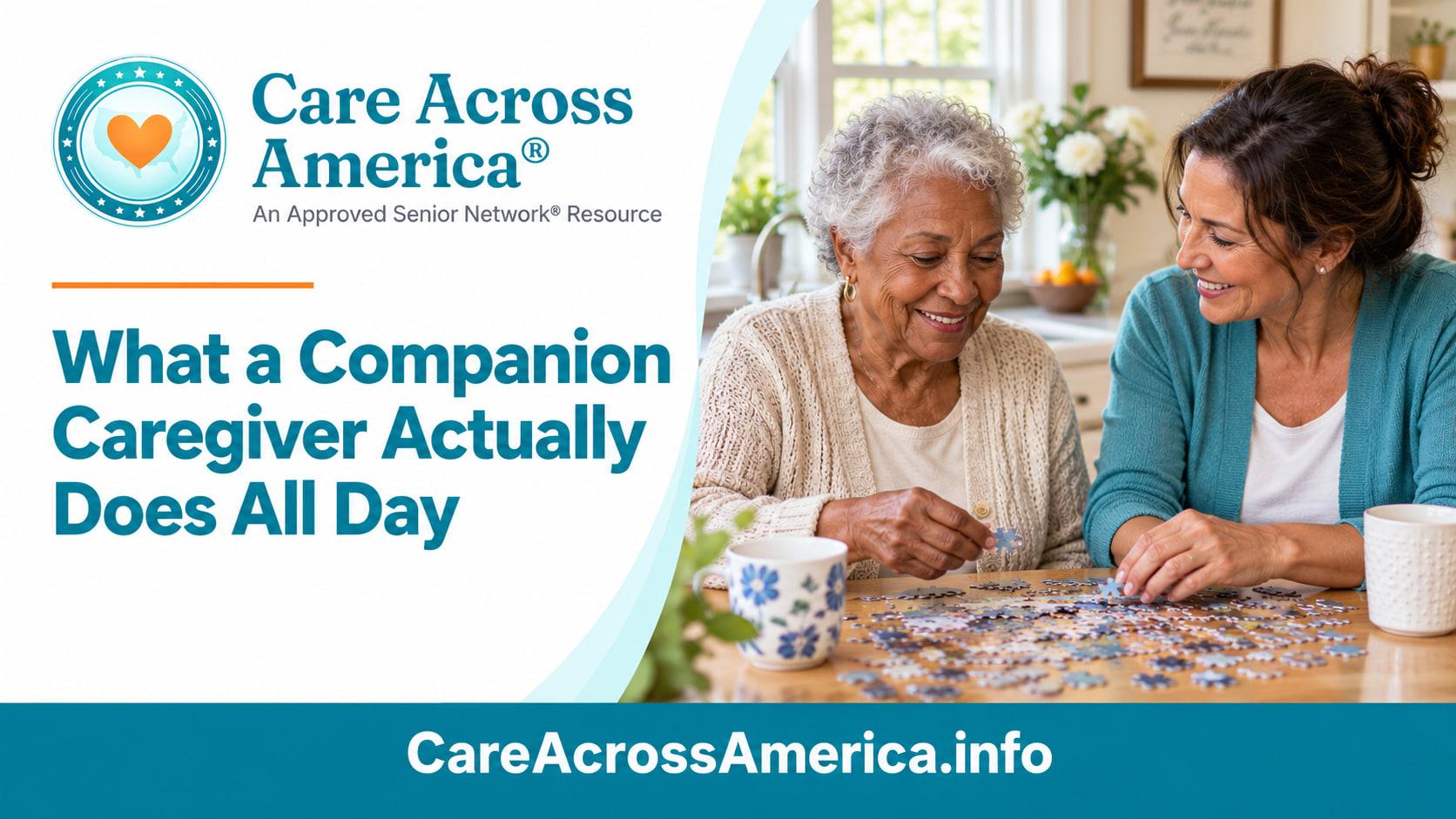
Almost every family asks some version of the same question.
"We would be paying someone to sit with her?"
It is a fair question, and the honest answer is that the sitting is the least of it.
What is companion care?
Companion care is non-medical home care. The caregiver is there for company, for supervision, and for the practical work of keeping a household and a day running.
What it does not include is hands-on help with the body. Bathing, dressing, toileting and transfers belong to personal care, which is a different service and usually a different rate.
What does a companion caregiver actually do in four hours?
Here is what a typical visit contains, and very little of it is sitting down.
Food. Not just cooking, but noticing. Checking what has actually been eaten since the last visit, clearing what has turned, building a shopping list, and making something the person will genuinely eat rather than something that looks balanced on paper.
The house. Laundry, dishes, changing sheets, tidying the paths people walk at night. Light housekeeping in home care is usually as much about fall risk as tidiness.
Getting out. Driving to appointments, the pharmacy, the grocery store, church, the salon. For many clients this is the single most valuable hour of the week, because it restores something that was lost when the car keys went.
Medication reminders. Not administering, but prompting, and noticing that Tuesday's compartment is still full.
The paperwork pile. Sorting mail, flagging the letter from the insurer, spotting the third notice that has been ignored.
Company. Cards, photographs, a walk, the same conversation about the same grandchildren. This is real work when it is done well.
Watching, without appearing to. A good caregiver leaves knowing whether the person seemed steadier or shakier than last time, whether they winced getting up, whether the bruise is new.
What a companion caregiver is not allowed to do
Being clear about the limits protects everyone.
Most companion caregivers do not provide hands-on personal care, do not administer medications, do not perform any nursing task such as wound care or injections, and do not make medical decisions.
The exact boundaries vary by state and by agency. Some states regulate non-medical home care closely and some barely at all. Ask a prospective agency, in plain words, what their caregivers can and cannot do where you live, and what happens when a client's needs cross that line.
Find a Home Care Provider Near You
Search the Care Across America directory to connect with trusted home care agencies serving your city and state.
Browse the Home Care DirectoryHow do I know if companion care is enough?
Companion care is usually the right starting point when someone is physically managing but the days have gone wrong.
Signs it is enough for now:
- They can bathe, dress and use the bathroom independently
- They are steady on their feet, with or without a stick or frame
- The problems are meals, isolation, transport, housekeeping and forgetfulness
Signs it is no longer enough:
- They are avoiding the shower because it frightens them
- Getting out of a chair or the bed has become a two-hand effort
- There have been falls, or near-falls they did not mention
- Continence has become an issue
- They cannot be left alone safely for the hours between visits
That second list is the point at which personal care, and sometimes overnight or 24-hour care, becomes the honest recommendation.
Why start before it is obviously necessary?
Because the alternative is starting during a crisis, and a crisis chooses for you.
Companion care is normally the least expensive level of home care. It is also the level most likely to prevent the event that forces every other decision. Someone in the house twice a week is someone who spots the infection, the weight loss, the untaken pills and the loose stair rail while they are still small problems.
It is also considerably easier to introduce. A person who has grown used to Marie coming on Tuesdays will accept Marie helping with a shower six months later. A stranger arriving on the day of discharge from hospital, when everything is frightening already, is a much harder sell.
The practical questions worth asking
When you call an agency, these tell you more than the brochure will:
- Will it be the same caregiver each visit, and who covers when they are sick?
- What is the minimum visit length? Many agencies will not staff less than three or four hours.
- What exactly are your caregivers permitted to do in this state?
- How do you match a caregiver to a person, beyond availability?
- What happens, concretely, when my mother needs more help than companion care covers?
The answer to the first and last questions tells you most of what you need to know about the agency.
For the full checklist, including licensing, screening, supervision and contracts, see our guide on how to choose a home care agency.
Frequently Asked Questions
What is companion care?
Companion care is non-medical home care focused on company, supervision, and help with the practical parts of running a household: meals, light housekeeping, laundry, errands, transport, medication reminders and keeping the day on track. It does not include hands-on personal care such as bathing or toileting, which is personal care.
What is the difference between companion care and personal care?
The dividing line is hands-on physical assistance with the body. Companion care covers the household and the day. Personal care adds bathing, dressing, grooming, toileting and transfers. Many families begin with companion care and add personal care later as needs change.
Can a companion caregiver give medication?
Generally no. Most companion caregivers may provide reminders, and may hand someone a prepared organiser, but they do not administer medication, manage doses or handle injections. Rules vary by state and by agency, so ask directly what a given caregiver is permitted to do where you live.
Is companion care worth paying for if my parent is physically fine?
Often yes, and it is usually the cheapest point at which to start. A physically capable person living alone can still stop eating properly, stop going out and stop being seen by anybody who would notice a change. Companion care is generally the least expensive level of home care and the one most likely to prevent a crisis rather than respond to one.
Written By
Valerie VanBooven RN BSN
Valerie VanBooven RN BSN is a registered nurse, wife, mom, and published author of several books on long-term care and elder care. She is the Founder and Co-Owner of Approved Senior Network® and the founder of Care Across America®.
More from Care Across America
Find a Home Care Provider Near You
Search the Care Across America directory to connect with trusted home care agencies serving your city and state.
Browse the Home Care DirectoryRecent Posts