
September 4, 2026
Does Medicare Pay for Home Care? What It Covers, What It Doesn't, and How to Pay for the Rest
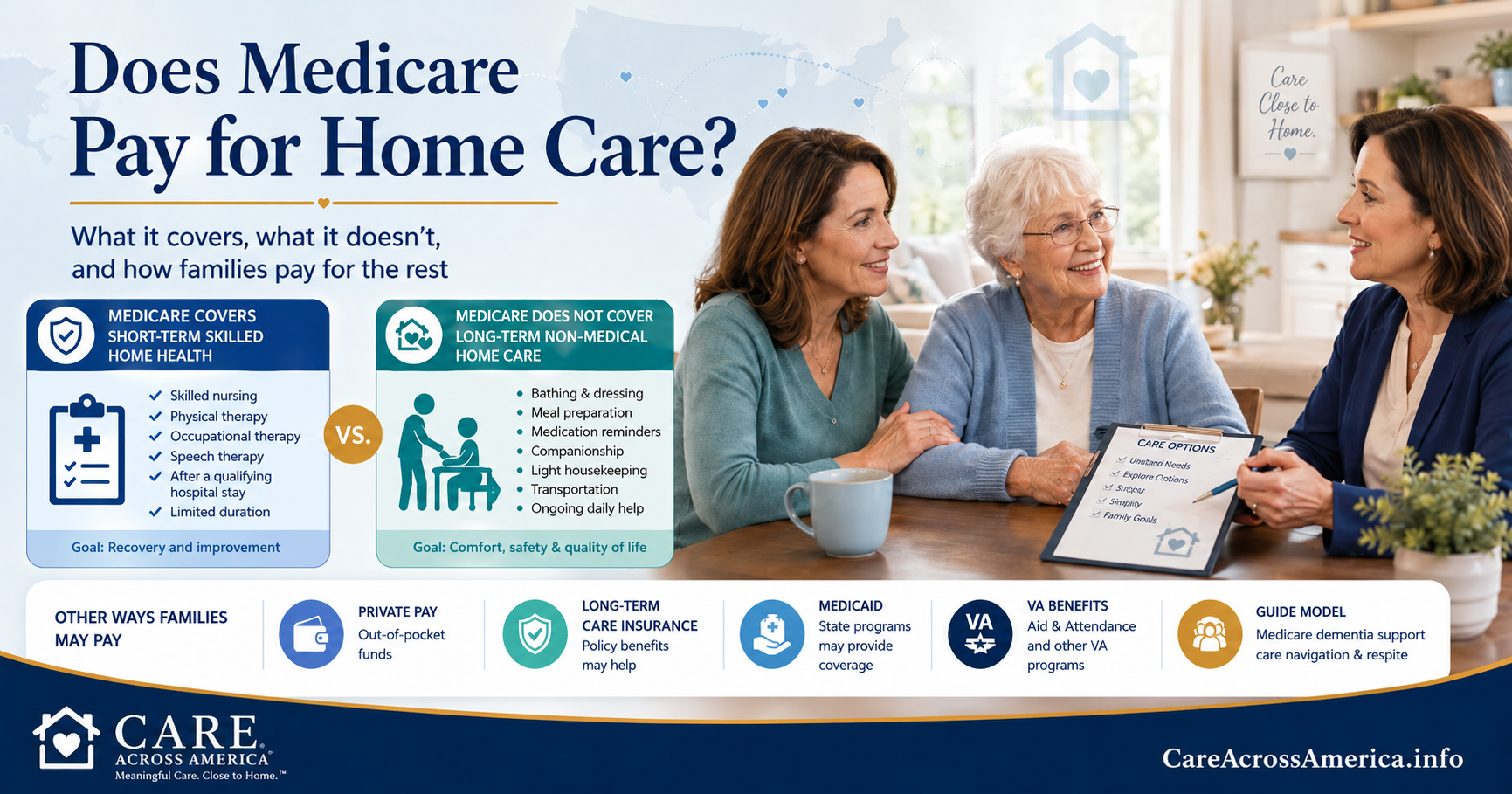
If you're trying to help an aging parent stay safely at home, you've probably run into a confusing wall of terms: home health, home care, custodial care, skilled care. Then you find out Medicare, the insurance your parent has paid into for decades, won't cover the help they actually need. That comes as a shock to most families, and it's the single most common misunderstanding in senior care planning.
Here's the short answer. Medicare pays for short-term, medical, skilled care at home. It does not pay for the long-term, hands-on help most aging parents eventually need, like bathing, dressing, meal preparation, or simply having someone in the house for safety. That kind of care is called non-medical home care, and it's usually paid for through private funds, long-term care insurance, Medicaid, or veterans' benefits.
Understanding this distinction now, before a crisis forces the issue, will save your family time, money, and a lot of stress.
Home Health Care vs. Home Care: They're Not the Same Thing
These two terms sound almost identical, but in the insurance and healthcare world, they mean very different things.
Home health care is medical treatment delivered at home by licensed professionals, usually a nurse or therapist, ordered by a doctor to treat a specific illness or injury. It's meant to be short-term and goal-oriented: heal a wound, recover from surgery, regain strength after a hospital stay.
Home care (also called non-medical home care, personal care, or custodial care) is hands-on help with everyday activities of daily living, or ADLs. That includes bathing, dressing, toileting, eating, and moving around safely, plus support like meal prep, light housekeeping, medication reminders, and companionship. It doesn't require a medical license, and it's often needed for months or years, not weeks.
A parent recovering from hip surgery might qualify for Medicare-covered home health for a few weeks. That same parent may need a caregiver's help getting dressed and to the bathroom safely for years afterward. Only the first kind is something Medicare was built to pay for.
What Medicare Actually Pays For
Medicare will cover home health care when your parent meets all of the following conditions:
- A doctor certifies the care is medically necessary and creates a care plan.
- Your parent needs skilled nursing care or therapy (physical, occupational, or speech) on a part-time or intermittent basis, not around-the-clock care.
- The care is provided by a Medicare-certified home health agency.
- Your parent is considered homebound, meaning leaving the house takes considerable effort or isn't medically advised.
Under these conditions, Medicare can cover skilled nursing visits, physical and occupational therapy, speech-language pathology, medical social services, and durable medical equipment. It will also cover a home health aide, but only as an add-on while your parent is already receiving skilled nursing or therapy, and only for hands-on care tied to the medical treatment.
What Medicare will not pay for, even from a Medicare-certified agency, includes 24-hour care at home, meal delivery, homemaker services like shopping and cleaning that aren't tied to a health condition, and personal care or supervision when that's the only help your parent needs. Once the skilled, short-term treatment ends, Medicare's involvement ends with it, even if your parent still needs daily help.
Why Won't Medicare Pay for Long-Term Care at Home?
This is the question every family eventually asks, and the answer isn't a loophole or an oversight. It's how Medicare was designed from the beginning.
Medicare was built in 1965 as health insurance for older Americans, modeled on the kind of insurance a younger working person carries: it treats illness and injury and helps people recover. It was never designed to be long-term care insurance, which covers ongoing support for people who can no longer safely manage daily life on their own, regardless of whether they're sick.
This same logic applies to nearly all traditional health insurance, including employer plans. Health insurance pays to diagnose and treat conditions. It generally does not pay for supervision, assistance, or custodial support that someone needs indefinitely, because that isn't treatment. That's the reason a hospital stay is covered but ongoing help with dressing and bathing typically is not, whether the insurance is Medicare, Medicaid managed care, or a private PPO.
This is exactly why long-term care planning is treated as its own category, separate from health insurance, and why families need to understand the funding sources built specifically to cover it.
Who Pays for Non-Medical Home Care?
Since Medicare and most health insurance are out of the picture, families typically rely on one or more of the following.
Private Pay
This is the most common way families cover non-medical home care, at least at first. Your parent or family pays a home care agency directly, out of savings, retirement income, or family contributions. It offers the most flexibility and the fastest start, since there's no eligibility process, but costs add up quickly with ongoing daily or weekly care.
Long-Term Care Insurance
A long-term care insurance policy, purchased in advance, pays a daily or monthly benefit toward home care, assisted living, or nursing home care once your parent meets the policy's benefit trigger, usually needing help with two or more ADLs or having a diagnosed cognitive impairment like dementia. Most policies have an elimination period, a waiting period of 30 to 90 days after the trigger before benefits begin, similar to a deductible measured in days instead of dollars. If your parent has an older policy, it's worth reviewing it now, before you need it, to understand exactly what it triggers on and what it pays.
Medicaid
Medicaid is the joint federal and state health insurance program for people with limited income and assets, and it is the largest single payer of long-term care in the country. Unlike Medicare, Medicaid was designed to cover custodial care, including long-term stays in a nursing home and, through state programs called Home and Community-Based Services (HCBS) waivers, personal care at home instead.
Eligibility depends on your state and typically requires meeting both a financial test (income and asset limits, generally around $2,000 in countable assets for an individual, though this varies) and a functional test showing your parent needs a nursing-home level of care. HCBS waivers are not automatic entitlements; many states have enrollment caps and waiting lists, so it's worth applying and asking about wait times as early as possible, well before a crisis hits. An elder law attorney or your local Area Agency on Aging can help you understand your state's specific rules and any spend-down strategies available.
Veterans Benefits: Aid and Attendance and CCN
Veterans and surviving spouses have two distinct paths worth understanding, and a veteran may be able to use both.
VA Aid and Attendance is a monthly pension benefit add-on for wartime veterans (or their surviving spouses) who need help with daily activities, are largely bedridden, or have significant vision loss. It's based on service history, income, and net worth (the asset limit is $163,699 through November 2026), not on a clinical assessment. The money goes directly to the veteran or family, who can use it flexibly to pay a home care agency, an assisted living community, or even a family caregiver.
VA Community Care Network (CCN), by contrast, is a clinical benefit. When the VA can't provide a service like Homemaker/Home Health Aide or respite care directly, it authorizes and pays a community home care agency on the veteran's behalf. Eligibility is based on medical need determined by the VA, not income, and the VA pays the agency directly rather than reimbursing the family.
Because these two programs run on completely different eligibility rules (one financial, one clinical) it's worth asking a Veterans Service Officer (VSO) to evaluate your parent for both.
Find a Home Care Provider Near You
Search the Care Across America directory to connect with trusted home care agencies serving your city and state.
Browse the Home Care DirectoryNew Help for Dementia Families: The GUIDE Model
If your parent has a dementia diagnosis, there's a newer Medicare program worth knowing about called the GUIDE Model (Guiding an Improved Dementia Experience). Launched in 2024 as an eight-year test program, GUIDE is available through Medicare Part B at participating provider organizations nationwide.
GUIDE assigns your family a care navigator, gives you 24/7 access to a support line for urgent questions, provides caregiver training and education, and covers up to $2,500 a year in respite care, meaning in-home care, adult day programs, or short facility stays that give the family caregiver a break. GUIDE pays special attention to families who qualify for both Medicare and Medicaid, coordinating support across both programs, which is likely why it's sometimes referred to alongside Medicaid programs even though it runs through Medicare. Ask your parent's neurologist, geriatrician, or primary care provider whether they participate, or whether a local health system does.
Medicare Home Health vs. Non-Medical Home Care, at a Glance
| Medicare Home Health | Non-Medical Home Care | |
|---|---|---|
| Purpose | Treat a specific illness or injury | Ongoing help with daily living |
| Who provides it | Nurses, therapists (licensed) | Trained caregivers/aides |
| Typical duration | Weeks, tied to recovery | Months to years |
| Requires doctor's order | Yes | No |
| Paid by Medicare | Yes, if criteria are met | No |
| Typical payers | Medicare, private insurance | Private pay, LTC insurance, Medicaid, VA benefits |
Where to Start
- Ask your parent's doctor whether a home health referral is appropriate right now, for any recent hospitalization, surgery, or new diagnosis.
- Pull out any long-term care insurance policy your parent owns and read the benefit triggers and elimination period before you need to file a claim.
- Contact your state's Medicaid office or Area Agency on Aging to ask about HCBS waiver programs and current wait times, even if you don't think you'll need it soon.
- If your parent is a veteran or surviving spouse, talk to a Veterans Service Officer about both Aid and Attendance and CCN homemaker/home health aide benefits.
- If dementia is part of the picture, ask about GUIDE Model participation at your parent's next appointment.
Frequently Asked Questions
Does Medicare pay for 24-hour home care? No. Medicare only covers part-time or intermittent skilled care, never round-the-clock supervision or care.
What's the real difference between home health care and home care? Home health is short-term medical treatment ordered by a doctor. Home care is ongoing, non-medical help with daily activities like bathing, dressing, and meal preparation.
Can my parent qualify for both Medicaid and VA benefits? Sometimes, though the two programs interact in ways that require careful planning. A benefits counselor or elder law attorney can review your parent's specific situation.
If my parent has Medicare Advantage instead of original Medicare, does that change anything? Some Medicare Advantage plans now offer limited supplemental benefits for personal care or respite, beyond what original Medicare covers. Check your parent's specific plan documents, since benefits vary widely by insurer and plan.
Program rules, benefit amounts, and eligibility limits change every year and vary by state. The figures in this article reflect 2026 rates and are provided for general education. Confirm current numbers with Medicare.gov, Medicaid.gov, VA.gov, or a qualified elder law attorney or benefits counselor before making care or financial decisions.
Frequently Asked Questions
Does Medicare pay for 24-hour home care?
No. Medicare only covers part-time or intermittent skilled care, never round-the-clock supervision or care.
What's the real difference between home health care and home care?
Home health is short-term medical treatment ordered by a doctor. Home care is ongoing, non-medical help with daily activities like bathing, dressing, and meal preparation.
Can my parent qualify for both Medicaid and VA benefits?
Sometimes, though the two programs interact in ways that require careful planning. A benefits counselor or elder law attorney can review your parent's specific situation.
If my parent has Medicare Advantage instead of original Medicare, does that change anything?
Some Medicare Advantage plans now offer limited supplemental benefits for personal care or respite, beyond what original Medicare covers. Check your parent's specific plan documents, since benefits vary widely by insurer and plan.
Written By
Valerie VanBooven RN BSN
Valerie VanBooven RN BSN is a registered nurse, wife, mom, and published author of several books on long-term care and elder care. She is the Founder and Co-Owner of Approved Senior Network® and the founder of Care Across America®.
Find a Home Care Provider Near You
Search the Care Across America directory to connect with trusted home care agencies serving your city and state.
Browse the Home Care DirectoryRecent Posts