
September 4, 2026
The Cost of Home Care in Nebraska and How to Pay for It (2026 Guide)
TLDR;
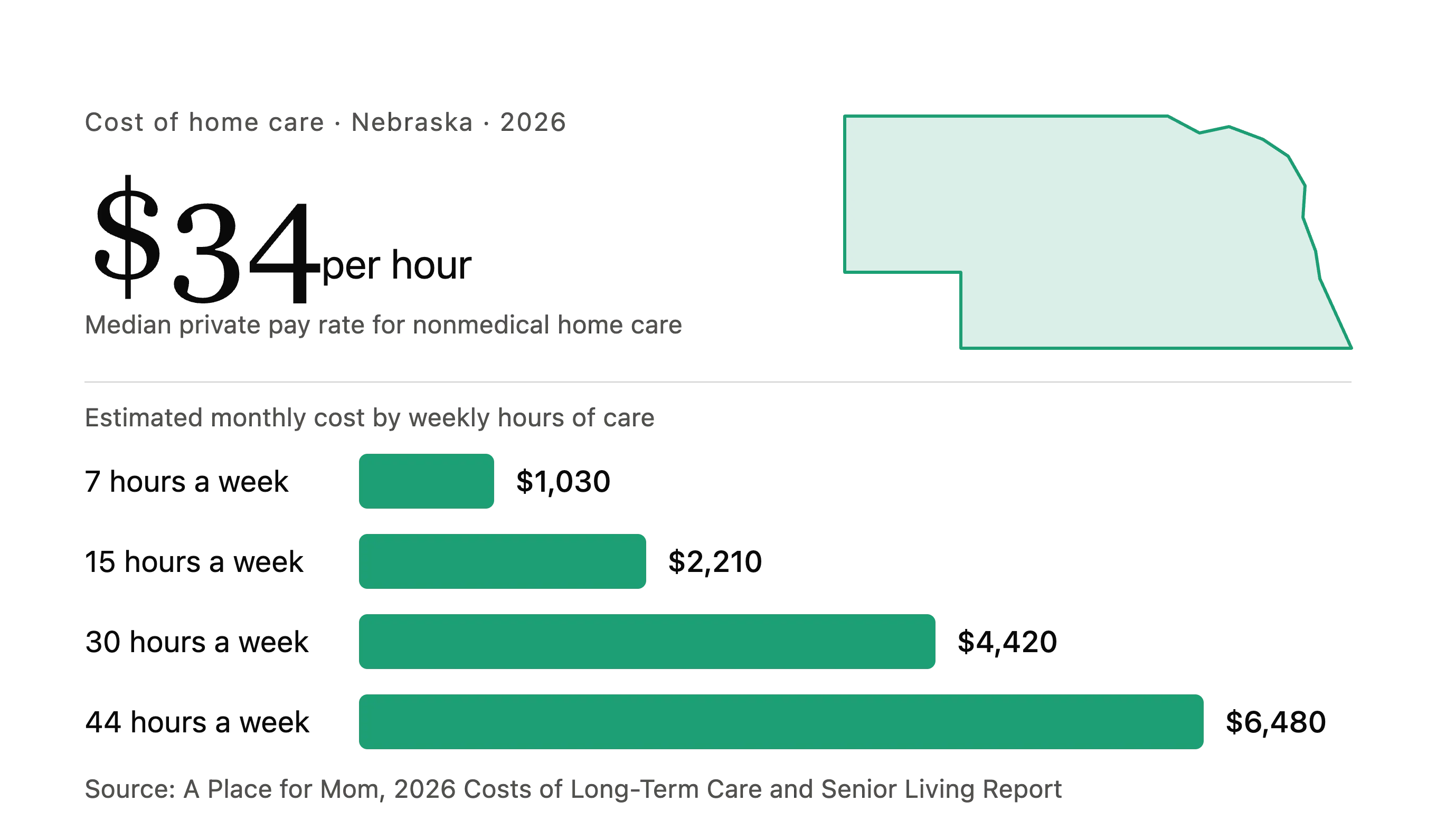
- The median private pay rate for nonmedical in-home care in Nebraska is about $34 per hour in 2026, matching the national median.
- A typical 30 hour per week schedule runs roughly $4,400 per month. Near full-time care at 44 hours per week runs roughly $6,500 per month.
- Medicare does not pay for long-term custodial home care. It pays for short-term skilled home health when a person is homebound and has a skilled need.
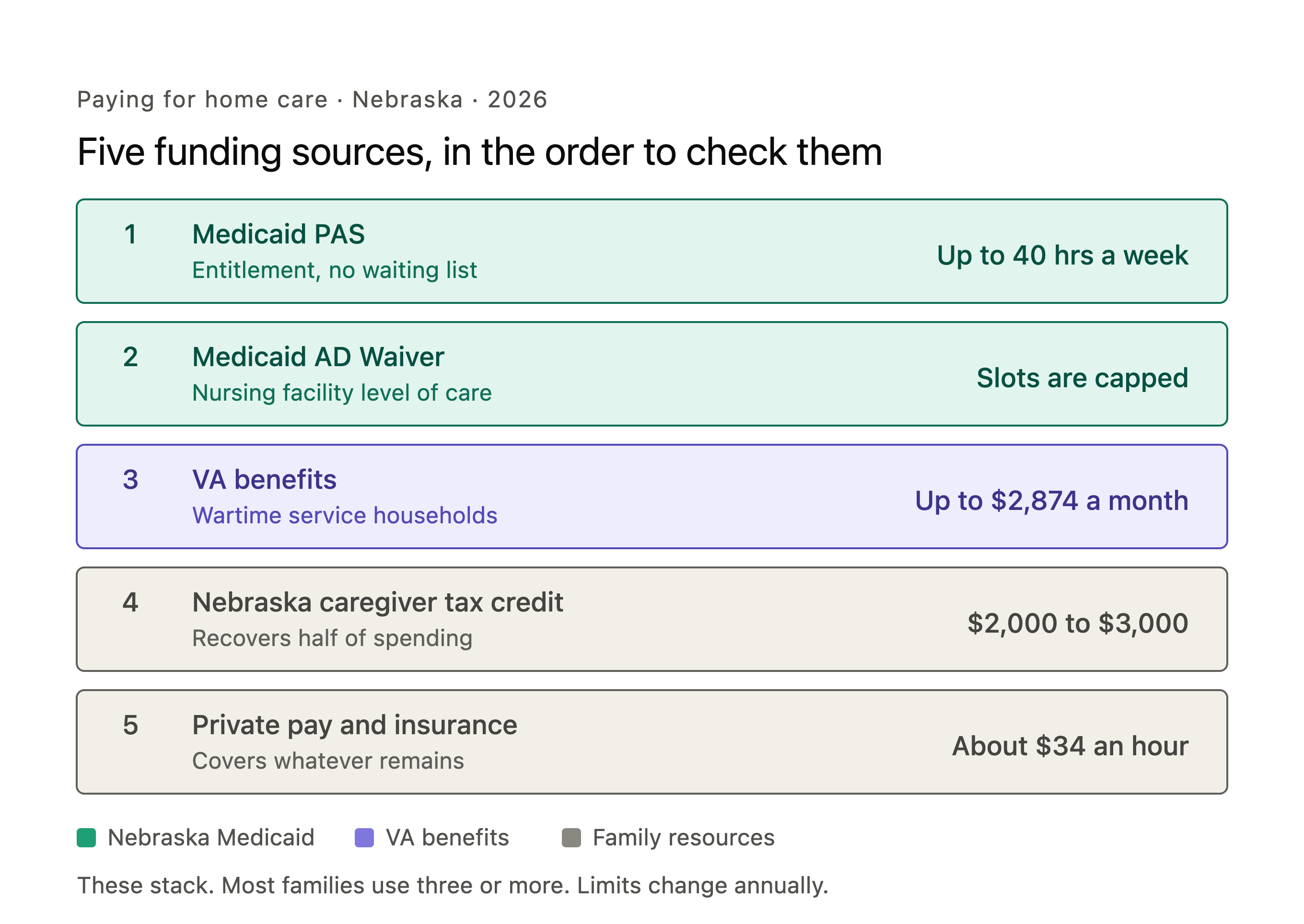
- Nebraska has two separate Medicaid routes to in-home personal care: State Plan Personal Assistance Services (PAS), an entitlement with no waiting list, and the Aged and Disabled (AD) Waiver, which has limited slots.
- Beyond Medicaid, Nebraska families use VA benefits, state-funded programs (SSAD, DPFS, Lifespan Respite), Older Americans Act services through Area Agencies on Aging, long-term care insurance, the Nebraska Caregiver Tax Credit, and personal assets.
Find Nebraska Home Care Providers Here.
Part 1: What Home Care Costs in Nebraska
The headline number
A Place for Mom's 2026 Costs of Long-Term Care and Senior Living Report puts the median hourly rate for private pay nonmedical home care in Nebraska at $34 per hour. That is exactly the national median. Median state rates nationally range from $25 per hour in Mississippi to $44 per hour in South Dakota, so Nebraska sits squarely in the middle of the country.
CareScout (formerly Genworth) reports a slightly higher national figure. Its 2025 Cost of Care Survey, published in March 2026, put the national median for a nonmedical caregiver at $35 per hour, a 3 percent year over year increase, which works out to $80,080 per year at 44 hours per week. CareScout also now combines homemaker and home health aide into a single "nonmedical caregiver" category because the two prices converged.
Monthly cost by care schedule
Using the $34 per hour Nebraska median and 4.33 weeks per month:
| Care schedule | Hours per week | Estimated monthly cost |
|---|---|---|
| Occasional help or companionship | 7 | About $1,030 |
| Part-time help with daily activities | 15 | About $2,210 |
| Regular weekday support | 30 | About $4,420 |
| Extensive in-home support | 44 | About $6,480 |
Live-in and 24/7 arrangements are priced differently by every agency and do not scale linearly from the hourly rate. Ask for a written rate sheet.
Why you will see very different numbers online
Three different things get labeled "the cost of home care," and they are not interchangeable:
- Agency billing rate. What a licensed home care agency charges the family. This is the $34 per hour figure. It includes wages, payroll taxes, workers' compensation, liability insurance, background checks, supervision, scheduling, and backup coverage.
- Caregiver pay rate. What the caregiver earns. Care.com reports average starting rates for Nebraska around $21 per hour, with Omaha at about $21 per hour. Indeed reports an average Nebraska home health aide wage of about $18 per hour. These are labor costs, not what a family pays an agency.
- Medicaid reimbursement rate. What the state pays. Nebraska's State Plan PAS fee schedule has historically sat far below private pay rates, which is why agency participation and availability vary by county.
Agencies typically charge 20 to 30 percent more than an independently hired caregiver. That premium buys accountability: vetting, supervision, tax and insurance compliance, and a replacement caregiver when someone calls off.
What drives cost up or down in Nebraska
- Geography. Omaha and Lincoln command higher rates than Grand Island, Scottsbluff, and the rural counties, driven by density, wage competition, and healthcare infrastructure.
- Level of care. Companion and homemaker visits cost less than hands-on ADL assistance. Dementia care and complex transfers cost more.
- Skilled nursing at home. CareScout began reporting private duty nursing separately in 2025 at a national median of $90 per hour or $160 per visit. This is a different service line from aide care.
- Shift length and minimums. Most agencies enforce a minimum visit length, often two to four hours. Short daily visits are the most expensive way to buy care per hour of coverage.
- Nights, weekends, and holidays. Differential rates are common.
How home care compares to facility care in Nebraska
| Care setting | Nebraska cost | Source |
|---|---|---|
| Nonmedical home care | About $34 per hour | A Place for Mom, 2026 |
| Assisted living | About $6,093 to $6,350 per month | CareScout 2025 Cost of Care Survey |
| Nursing home, semi-private room | About $8,377 per month (roughly $100,558 per year) | CareScout / Genworth |
| Nursing home, private room | About $10,038 per month (roughly $120,450 per year) | CareScout / Genworth |
The crossover point matters for families. Below roughly 40 hours per week, home care is usually the lower cost option. Above that, assisted living often becomes cheaper on a pure dollar basis, though it trades away the one-to-one attention and the home itself.
Find a Home Care Provider Near You
Search the Care Across America directory to connect with trusted home care agencies serving your city and state.
Browse the Home Care DirectoryPart 2: Every Way to Pay for Home Care in Nebraska
1. Private pay
Most Nebraska families start here. Sources include Social Security and pension income, retirement accounts, savings, adult children contributing, home equity, and proceeds from downsizing. Private pay is also the bridge that covers care while a Medicaid or VA application is pending, and those applications can take months.
2. Medicare
Medicare is the most misunderstood piece of this puzzle. It covers home health, not home care.
What Medicare covers:
- Part-time or intermittent skilled nursing care
- Physical therapy, occupational therapy, and speech-language pathology
- Medical social services
- A home health aide, but only while skilled care is also being delivered
- Durable medical equipment at 80 percent after the Part B deductible ($283 in 2026)
Requirements:
- A doctor certifies the person is homebound, meaning leaving home takes considerable and taxing effort
- There is a skilled nursing or therapy need
- A physician-ordered plan of care is in place
- Services come from a Medicare-certified home health agency
Limits: Coverage is intermittent, generally up to 8 hours per day and 28 hours per week combined, and up to 35 hours per week for a short period when clinically justified. Covered services carry no copay, coinsurance, or deductible.
What Medicare does not cover: 24-hour care at home, meal delivery, homemaker services unrelated to the care plan, and custodial personal care when that is the only need. If a parent needs help bathing and dressing but has no skilled need, Medicare pays nothing.
Medicare Advantage. Some Medicare Advantage plans offer supplemental in-home support benefits, personal emergency response systems, meal delivery after discharge, or transportation. These vary by plan and by county. Check the plan's Evidence of Coverage before assuming a benefit exists.
3. Nebraska Medicaid: State Plan Personal Assistance Services (PAS)
This is the option most often missed.
- PAS is a Medicaid State Plan benefit, which makes it an entitlement. If a person qualifies, they receive services. There is no waiting list.
- It does not require nursing facility level of care, unlike the AD Waiver.
- Services include bathing, dressing, toileting, mobility and transfers, eating, meal preparation, light housekeeping, essential shopping, and medication administration to the extent state law permits.
- Support is not limited to inside the home. It can follow the person to appointments or adult day programs.
- Participants can self-direct, choosing their own provider. Family members can be hired as paid providers, with the important exception that spouses and legally responsible individuals cannot be paid under PAS.
- PAS is excluded from Heritage Health managed care and remains fee-for-service.
- Electronic Visit Verification is required for PAS providers.
Apply through Nebraska DHHS. The program is administered by the Division of Medicaid and Long-Term Care.
4. Nebraska Medicaid: Aged and Disabled (AD) Waiver
The AD Waiver is a 1915(c) Home and Community Based Services waiver, formally called the HCBS Waiver for Aged and Adults and Children with Disabilities.
Services available: Adult Day Health, Assisted Living (services only, not room and board), Assistive Technology, Chore, Companion, Extra Care for Children with Disabilities, Home Again (nursing facility transition), Home and Vehicle Modifications, Home-Delivered Meals, Independence Skills Building, LRI Personal Care, Non-Medical Transportation, Personal Care, Personal Emergency Response Systems, and Respite.
Eligibility:
- Enrolled in Nebraska Medicaid
- Age 65 or older, or has a disability at any age
- Meets Nursing Facility Level of Care, assessed with the interRAI Home Care tool
- Has a demonstrated need for waiver services
The NFLOC standard is met when one of these is true: limitations in at least 3 ADLs plus at least 1 risk factor; 3 ADLs plus 1 medical condition or treatment; 3 ADLs plus 1 area of limited cognition; or 1 ADL plus 1 risk factor plus 1 area of limited cognition. A dementia diagnosis alone does not automatically qualify.
2026 financial criteria:
- Income: $1,330 per month for the applicant, equal to 100 percent of the Federal Poverty Level. When only one spouse applies, only the applicant's income counts.
- Spousal income allowance: The community spouse may receive a Monthly Maintenance Needs Allowance with a minimum of $2,705 per month (effective July 1, 2026 through June 30, 2027) and a maximum of $4,066 per month, depending on shelter and utility costs.
- Assets: $4,000 for a single applicant, $8,000 when both spouses apply. With one applicant, the Community Spouse Resource Allowance lets the non-applicant spouse keep 50 percent of countable assets up to $162,660, with a floor of $32,532.
- Home equity: Exempt if the applicant lives there or intends to return and equity interest does not exceed $752,000. Also exempt if a spouse, minor child, or disabled child lives in the home.
- Look-back: 60 months. Transfers for less than fair market value trigger a penalty period.
Important structural points:
- The AD Waiver is not an entitlement. Slots are capped, currently around 10,000, and a waiting list can form. Priority goes to people whose health or safety is at risk.
- Participants choose an agency provider or an independent provider whom they hire and supervise, with the state issuing payment. Friends and relatives, including an adult child or a spouse, can be enrolled as an independent provider under the waiver. This differs from PAS.
- LRI Personal Care specifically allows a legally responsible individual to be the paid provider under defined conditions.
- Every participant receives a Service Coordinator. As of April 1, 2026, the League of Human Dignity no longer provides AD Waiver service coordination. Those participants transitioned to DHHS service coordinators. People 65 and older may choose their Area Agency on Aging as service coordinator.
How to apply: Online at iServe Nebraska, by downloading the HCBS Waiver application, or by calling 877-667-6266 to request a mailed application. Expect up to 3 months, sometimes longer, from application to determination.
If income or assets are too high: Nebraska has a medically needy spend-down pathway. Excess income is applied to medical expenses and premiums each month to reach the medically needy limit, and the waiver covers services for the rest of that month. Irrevocable funeral trusts, Medicaid asset protection trusts implemented well in advance, and other planning strategies exist. These interact with the 60-month look-back and should be handled by a licensed elder law attorney or certified Medicaid planner.
Estate recovery: Nebraska operates a Medicaid Estate Recovery Program. The home may be exempt during life and still be subject to recovery afterward. This is a legal question for an attorney.
5. PACE (Program of All-Inclusive Care for the Elderly)
PACE bundles all Medicare and Medicaid services under one capitated program for people 55 and older who meet nursing home level of care but want to stay at home. It covers primary care, prescriptions, therapies, transportation, adult day services, home care, hospital care, and nursing home care when needed.
Nebraska availability is limited. Immanuel Pathways Eastern Nebraska in Omaha is the state's only approved PACE provider, serving all of Douglas and Sarpy counties. Most participants are dually eligible for Medicare and Medicaid. Participants can be personally liable for unauthorized out-of-network services, so the model requires committing to the PACE care team.
6. VA benefits
Veterans and surviving spouses have the widest set of options and the most underused ones.
Aid and Attendance / Housebound pension. A tax-free monthly benefit for wartime veterans and surviving spouses with a care need and limited income and net worth. It can be spent on in-home care, including care from a family member.
2026 maximum annual pension rates, effective December 1, 2025 through November 30, 2026:
| Category | Aid and Attendance MAPR |
|---|---|
| Veteran, no dependents | About $29,093 per year (about $2,424 per month) |
| Veteran with one dependent | About $34,486 per year (about $2,874 per month) |
| Surviving spouse | About $18,697 per year (about $1,558 per month) |
The net worth limit for the same period is $163,699, including assets plus annual income, excluding the primary residence and personal belongings. There is a 36-month look-back on asset transfers. Actual payment equals MAPR minus countable income, divided by 12. Unreimbursed medical expenses, including home care costs, reduce countable income, which is why many applicants with heavy care costs receive the full amount.
Homemaker and Home Health Aide Care. Part of the VHA Standard Medical Benefits Package for enrolled veterans with a clinical need. VA contracts with community home health agencies. Copays may apply based on service-connected status and income, though VA geriatric home care generally requires no copay for the first 21 days in a year.
Veteran-Directed Care. The veteran receives a flexible budget and chooses their own services and providers, including hiring family members in many cases.
Home-Based Primary Care. A VA clinical team delivers primary care in the home for veterans with complex conditions who cannot easily travel to a VA facility.
Respite Care and Adult Day Health Care. Available through VA Geriatrics and Extended Care.
Program of Comprehensive Assistance for Family Caregivers (PCAFC). Pays a monthly stipend directly to the designated primary family caregiver of an eligible veteran, plus training, counseling, and respite. Eligibility rules are strict and separate from the pension programs.
Start with the social worker or care coordinator at the veteran's VA medical center.
7. Nebraska state-funded programs (non-Medicaid)
These are smaller dollar amounts, but they are real and they stack.
Social Services for Aged and Disabled Adults (SSAD). State-funded help for people 60 and older, or blind or disabled adults, who need support to remain independent. Services include chore assistance (light housekeeping, essential shopping, food preparation, laundry, and limited personal care such as bathing, dressing, shaving, and shampooing), adult day services, home-delivered meals, congregate meals, and non-medical transportation. Income and resource tests apply. SSAD only funds services not covered by Medicaid or another program.
Disabled Persons and Family Support (DPFS). State-funded assistance for people of any age with a medically determinable severe, chronic disability. Eligible participants may receive up to $400 per month or $4,800 per year for authorized services including attendant care, home health care, housekeeping, respite care, home modifications, special equipment, and transportation. Applicants cannot be Medicaid eligible. Income and resource tests apply and a waiting list may exist.
Nebraska Lifespan Respite Program. Pays for respite so an unpaid primary family caregiver can take a break. Provides up to $125 per month for planned respite per client, plus up to $2,000 per eligibility period for approved Exceptional Circumstances including crisis respite. Not available to people already receiving respite from another government program, including the AD Waiver. Administered by DHHS with a statewide network of Lifespan Respite Network Coordinators.
8. Older Americans Act services and Area Agencies on Aging
Nebraska has eight Area Agencies on Aging covering the state, plus Aging and Disability Resource Centers. They are the front door for non-Medicaid help and cost nothing to call.
Typical services:
- Information, referral, and options counseling through the ADRC
- National Family Caregiver Support Program (Title III-E): in-home respite, adult day vouchers, caregiver training, counseling, support groups, and limited supplemental services such as transportation and home modifications, for caregivers of adults 60 and older
- Home-delivered and congregate meals
- Senior Care Options care management for older Nebraskans considering nursing home admission
- Housekeeping and supportive services, transportation, and personal care in some regions
- Long-Term Care Ombudsman services
AAAs also serve as AD Waiver service coordinators for participants 65 and older.
9. Long-term care insurance
If a policy exists, read the benefit trigger, elimination period, daily or monthly benefit cap, and whether it covers home care at the same rate as facility care. Most modern policies require inability to perform two of six ADLs, or severe cognitive impairment, certified by a licensed health care practitioner. Elimination periods of 30 to 90 days are common, and the family pays out of pocket during that window.
Nebraska Long-Term Care Partnership Program. Nebraska has participated since July 1, 2006. A qualified Partnership policy provides dollar-for-dollar asset disregard: for every dollar the policy pays in benefits, one dollar of the policyholder's assets is disregarded when Medicaid eligibility is calculated, and that same amount is excluded from Medicaid estate recovery. Nebraska honors qualifying Partnership policies issued in other reciprocal states. Policies are regulated by the Nebraska Department of Insurance.
Hybrid life insurance and annuity products with long-term care riders are also common now, and some existing life insurance policies can be converted into a long-term care benefit plan. These are financial products with real tradeoffs. Talk to a licensed advisor.
10. Nebraska Caregiver Tax Credit Act
Effective for tax years beginning on or after January 1, 2025, Nebraska offers a nonrefundable state income tax credit for unpaid family caregivers.
- Amount: 50 percent of eligible expenditures, capped at $2,000, or $3,000 if the family member is a veteran or has a dementia diagnosis
- Eligible expenses: home modifications, hiring a home care aide, respite care, adult day care, health care equipment, and assistive technology
- Caregiver income limits: federal AGI under $50,000 for single filers, or under $100,000 for married filing jointly
- Care recipient: a dependent, spouse, parent, or other relative by blood or marriage who lives in a private residence and requires assistance with at least two activities of daily living, certified by a licensed health care provider
- Process: an application must be filed with the Nebraska Department of Revenue with documentation of expenditures. Credits are approved in the order received.
- Statewide cap: $1.5 million in fiscal years 2025-26 and 2026-27, rising to $2.5 million in later fiscal years. Apply early. Statutory authority is Neb. Rev. Stat. sections 77-3163 to 77-3166.
11. Federal tax deductions
Unreimbursed medical expenses exceeding 7.5 percent of adjusted gross income can be claimed as an itemized deduction. Medically necessary help with activities of daily living may qualify. Purely household help does not. Adult children who provide more than half of a parent's support may be able to claim the parent as a dependent or use the Credit for Other Dependents. Confirm specifics with a CPA.
12. Personal assets and home equity
Options families use, each with meaningful tradeoffs:
- Reverse mortgage (HECM) for homeowners 62 and older who intend to stay in the home
- Home equity line of credit if income supports repayment
- Life settlement or accelerated death benefit to convert an existing life insurance policy
- Immediate annuity to convert a lump sum into guaranteed monthly income
- Bridge loans designed for senior care while a benefit application is pending
- Renting a room or selling the second vehicle, the unglamorous options that often close the gap
Every one of these can affect Medicaid eligibility, VA net worth calculations, or estate plans. Coordinate with an elder law attorney before executing.
Part 3: A Practical Order of Operations
- Get a needs assessment. Hours and level of care determine everything downstream. Many agencies do this at no charge.
- Call the Area Agency on Aging or the ADRC first. It is free, it maps what is available in that specific county, and it is where Older Americans Act services live.
- Screen for VA eligibility immediately if the person or their late spouse served. Aid and Attendance alone can cover 10 to 20 hours per week of care.
- Screen for Medicaid PAS before the AD Waiver. PAS is an entitlement with no waiting list and no nursing facility level of care requirement. It is the faster path for many people.
- Apply for the AD Waiver if nursing facility level of care is met. Do it early, because a waiting list can form.
- Check for a Medicare skilled home health episode after any hospitalization, surgery, or functional decline. It costs nothing and often surfaces needs the family had not documented.
- Layer the small programs. Lifespan Respite, DPFS, and SSAD are modest individually and meaningful in combination.
- File for the Nebraska Caregiver Tax Credit if a family member is paying out of pocket and meets the AGI limits. The statewide cap is small and first-come.
- Bring in an elder law attorney before moving assets, signing a personal care agreement with a family member, or executing any home equity strategy.
Bottom Line
Home care in Nebraska costs about $34 an hour, which puts a meaningful part-time schedule in the $2,200 to $4,400 per month range and near full-time coverage above $6,000. There is no single payer that covers it. Nebraska families fund home care by stacking sources: Medicaid PAS or the AD Waiver for those who qualify financially, VA benefits for veteran households, Older Americans Act services and small state programs to fill gaps, insurance where it exists, tax credits and deductions to recover part of the spend, and personal assets for the rest. Families who start the conversation before a crisis consistently end up with more options and lower costs than families who start in a hospital discharge meeting.
Sources
Cost data
- A Place for Mom, "How Much Does In-Home Care Cost in 2026?" and 2026 Costs of Long-Term Care and Senior Living Report. https://www.aplaceformom.com/caregiver-resources/articles/in-home-care-costs
- CareScout, Cost of Long Term Care by State (2025 Cost of Care Survey, published March 2026). https://www.carescout.com/cost-of-care
- Genworth Financial, "CareScout Releases 2025 Cost of Care Survey Results." https://investor.genworth.com/news-events/press-releases/detail/1054/carescout-releases-2025-cost-of-care-survey-results
- Genworth Financial, "Genworth and CareScout Release Cost of Care Survey Results for 2024." https://investor.genworth.com/news-events/press-releases/detail/982/genworth-and-carescout-release-cost-of-care-survey-results
- Care.com, "How much does home care cost in Omaha, NE?" https://www.care.com/cost/home-care/omaha-ne
- Indeed, Home health aide salary in Nebraska. https://www.indeed.com/career/home-health-aide/salaries/NE
- SeniorLiving.org, "Average Senior In-Home Care Costs in 2026." https://www.seniorliving.org/home-care/costs/
- U.S. News & World Report, "2026 In-Home Care Costs: A Complete Guide to Pricing and Payment Options." https://health.usnews.com/home-care/articles/how-much-do-in-home-caregivers-cost
Nebraska Medicaid
- Nebraska DHHS, "Services on the Aged and Disabled Waiver." https://dhhs.ne.gov/Pages/Medicaid-Aged-and-Disabled-Waiver.aspx
- Nebraska DHHS, AD Waiver Services Quick Guide (July 2025). https://dhhs.ne.gov/DD%20Documents/AD%20Waiver%20Quick%20Guide.pdf
- Nebraska DHHS, AD Waiver Info Sheet. https://dhhs.ne.gov/DD%20Documents/AD%20Waiver%20Info%20Sheet.pdf
- American Council on Aging / MedicaidPlanningAssistance.org, "Nebraska Medical Assistance Program (NMAP) Aged and Disabled (AD) Waiver," updated June 5, 2026. https://www.medicaidplanningassistance.org/nebraska-aged-disabled-waiver/
- American Council on Aging / MedicaidPlanningAssistance.org, "Nebraska's State Plan Medicaid Personal Assistance Services (PAS)." https://www.medicaidplanningassistance.org/nebraska-personal-assistance-services/
- PayingForSeniorCare.com, "Nebraska Medicaid Personal Assistance Services (PAS)." https://www.payingforseniorcare.com/nebraska/medicaid-waivers/personal-assistance-services
- Nebraska DHHS, Provider Bulletin 25-03A, Upcoming Changes to EVV. https://dhhs.ne.gov/Guidance%20Docs/Provider%20Bulletin%2025-03A%20-%20Upcoming%20Changes%20to%20EVV.pdf
- iServe Nebraska (Medicaid and HCBS Waiver applications). https://iserve.nebraska.gov
- Eastern Nebraska Office on Aging, "Aged & Disabled Medicaid Waiver." https://enoa.org/programs/choices/aged-disabled-medicaid-waiver.html
PACE
- Nebraska DHHS, "All-Inclusive Care for the Elderly." https://dhhs.ne.gov/Pages/Medicaid-Provider-All-Inclusive-Care-for-the-Elderly.aspx
- Immanuel Pathways Eastern Nebraska (PACE). https://immanuel.com/pathways-pace/immanuel-pathways-eastern-nebraska
Medicare
- Medicare Rights Center, "Understanding Medicare Home Health Care," January 2026. https://www.medicarerights.org/medicare-answers/2026/01/28/understanding-medicare-home-health-care
- Medicare.org, "Does Medicare Cover Home Health Care?" https://www.medicare.org/articles/does-medicare-cover-home-health-aides/
- U.S. News & World Report, "Does Medicare Cover Home Health Care? Eligibility, Costs and Rules." https://health.usnews.com/medicare/articles/does-medicare-cover-home-health-care
VA benefits
- U.S. Department of Veterans Affairs, Geriatrics and Extended Care, Home and Community Based Services. https://www.va.gov/geriatrics/pages/Home_and_Community_Based_Services.asp
- U.S. Department of Veterans Affairs, Veterans Pension Rates. https://www.va.gov/pension/veterans-pension-rates/
- American Council on Aging / MedicaidPlanningAssistance.org, "VA Aid & Attendance Pension: 2026 Benefits & Eligibility Criteria." https://www.medicaidplanningassistance.org/va-pension-aid-and-attendance/
- VA Loan Network, "2026 Veterans Pension Rates: MAPR, Aid & Attendance, and Housebound Benefits." https://valoannetwork.com/2026-veterans-pension-rates-mapr-aid-attendance/
- A Place for Mom, "Home Care Options for Veterans: Eligibility and Support." https://www.aplaceformom.com/caregiver-resources/articles/home-care-for-veterans
Nebraska state-funded programs
- Nebraska DHHS, "Social Services Aged and Disabled Adults." https://dhhs.ne.gov/Pages/Social-Services-Aged-and-Disabled-Adults.aspx
- Nebraska DHHS, "Disabled Persons and Family Support." https://dhhs.ne.gov/Pages/Disabled-Persons-and-Family-Support.aspx
- Nebraska DHHS, "Lifespan Respite." https://dhhs.ne.gov/Pages/Respite.aspx
- Nebraska Lifespan Respite Network. https://respite.ne.gov
- Nebraska Administrative Code Title 473, Chapter 4, Section 473-4-001, Chore Service. https://regulations.justia.com/states/nebraska/health-and-human-services-system/title-473/chapter-4/section-473-4-001
Area Agencies on Aging and caregiver support
- Nebraska Lifespan Respite Network, "Aging and Disability Resource Center & Area Agencies on Aging." https://www.respite.nebraska.gov/aging-and-disability-resource-center-area-agencies-aging
- Family Caregiver Alliance, "Services By State: Nebraska." https://www.caregiver.org/connecting-caregivers/services-by-state/nebraska/
- Administration for Community Living, National Family Caregiver Support Program. https://acl.gov/programs/support-caregivers/national-family-caregiver-support-program
- Nebraska Judicial Branch, Office of Public Guardian, Aging & Adult Resources. https://nebraskajudicial.gov/programs-services/office-public-guardian/resources-private-guardians-and-conservators/opg-aging-adult-resources
Long-term care insurance
- Nebraska Department of Insurance, Long-Term Care. https://doi.nebraska.gov/long-term-care
- 471 Neb. Admin. Code ch. 38, section 005, Long-Term Care Partnership Program. https://www.law.cornell.edu/regulations/nebraska/471-Neb-Admin-Code-ch-38-SS-005
Tax credits
- Nebraska Department of Revenue, Caregiver Tax Credit Act. https://revenue.nebraska.gov/caregiver-tax-credit-act
- Nebraska Legislature, Neb. Rev. Stat. sections 77-3163 to 77-3166 (Caregiver Tax Credit Act). https://nebraskalegislature.gov/laws/display_html.php?begin_section=77-3163&end_section=77-3166
- Nebraska DHHS, "Caregiver Tax Credits Available for Family Caregivers through the Caregiver Tax Credit Act." https://dhhs.ne.gov/Pages/Caregiver-Tax-Credits-Available-for-Family-Caregivers-through-the-Caregiver-Tax-Credit-Act.aspx
- Nebraska Legislature, Unicameral Update, "Tax credits for caregivers, others created." https://update.legislature.ne.gov/?p=36526
This article is for general education. It is not legal, tax, financial, or clinical advice. Program rules, dollar limits, and eligibility thresholds change, often annually. Verify current figures with the administering agency, and consult a licensed elder law attorney, tax professional, or financial advisor before acting on any strategy described here.
Cost figures reflect data published through mid-2026. Nebraska Medicaid income, asset, and allowance figures reflect 2026 values and are adjusted each January or July depending on the figure. VA pension rates are effective December 1, 2025 through November 30, 2026.
Written By
Valerie VanBooven RN BSN
Valerie VanBooven RN BSN is a registered nurse, wife, mom, and published author of several books on long-term care and elder care. She is the Founder and Co-Owner of Approved Senior Network® and the founder of Care Across America®.
More from Care Across America
Find a Home Care Provider Near You
Search the Care Across America directory to connect with trusted home care agencies serving your city and state.
Browse the Home Care DirectoryRecent Posts